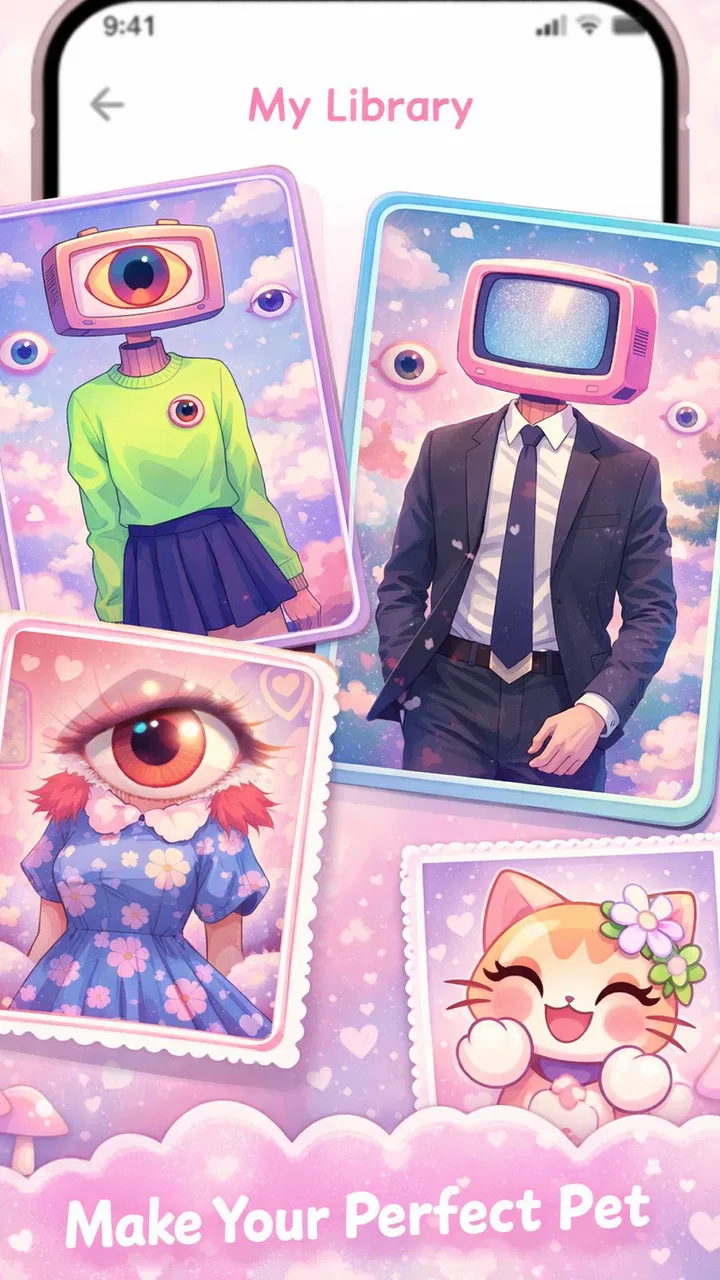
Dreamcore & Weirdcore Maker
- 3.0
- Rating
- 1.00M
- Installs
- Free
- Price

 Analysis by App-foxy
I approached Dreamcore & Weirdcore Maker as a quick creative tool rather than a full illustration studio, and that distinction matters. It belongs to the Art & Design category, from Revivoskin, and its appeal is easy to understand: you can build dreamy, strange-looking avatars without starting with a blank canvas. I found the concept inviting when I wanted an unusual profile image or a visual idea that felt more surreal than polished.
The app is free, aimed at Everyone, and has passed half a million installs. Its average rating sits at 3.1 from roughly nine hundred ratings, which suggests a mixed experience rather than a universally smooth one. After spending time with it, I can see why: the creative idea is accessible and distinctive, but the value depends heavily on whether you want fast experimentation or detailed control.
How the creative workflow feels in everyday use
The best way to use this app is to treat each avatar as a visual sketch. I would not open it expecting the depth of a professional drawing package. Instead, I would open it when I have a mood in mind—lonely hallway, soft fantasy character, unsettling dream figure—and want to turn that mood into something shareable with minimal setup.
You May Also Like

 Blood Strike: 2.5 Anniversary
Blood Strike’s Loadouts Turn Every Drop Into a Tactical Gamble
A close look at Blood Strike’s custom loadouts: how fast access to signature weapons reshapes its battle royale rhythm, rewards preparation, and narrows the gap between fights.

 Pandora - Music & Podcasts
Pandora’s Music Is Easy to Start, but Harder to Recover
Pandora’s strength is its low-effort path from a seed to a station. Its weak spot is how much confidence it asks you to place in connection, setup, and quiet recovery.

 8 Ball Pool
 Is Built on Rivalries, Rematches, and Routine
A close look at the rivalries, rematches, shared routines, and unanswered safety questions that turn a quick pool match into a persistent mobile community.

 Samsung Music
’s Quiet Strength Is Playing What You Already Own
Its reach comes less from spectacle than from dependable access to a personal library. That simplicity is both the app’s strongest retention engine and its ceiling.

 AccuWeather: Weather Radar
AccuWeather Review: A Quick, Clear Forecast for Everyday Decisions
For everyday plans, the best forecast is the one you can understand quickly. AccuWeather makes rain timing, radar, and local conditions easy to act on, with a few trade-offs.

 Hill Climb Racing
Why Hill Climb Racing Still Turns Crashes Into One More Run
A tiny car, a bumpy hill and one more upgrade: Hill Climb Racing keeps resurfacing because its simple chaos makes every near-miss feel personal.
More From Our News Desk



That makes it particularly useful for social profile images, mood boards, character references, chat avatars, and small personal projects. It can also help when you are stuck at the beginning of a design. Rather than spending ten minutes deciding what to draw, I can use the app to explore a direction, notice which colors or visual combinations work, and then carry that idea into a more advanced editor if necessary.
The important trade-off is convenience versus precision. A focused avatar maker can get me to an interesting result faster than a general-purpose drawing app, but it also limits how far I can refine the result. If your goal is a finished illustration with carefully controlled anatomy, lettering, lighting, or composition, I would choose a dedicated art app instead. This one makes more sense as a playful generator and starting point.
Why the unusual visual style is the main attraction
Many avatar tools aim for clean portraits, polished cartoon faces, or familiar social-media aesthetics. This app takes a different route by focusing on dreamcore and weirdcore-inspired imagery. That gives it a clearer personality than a generic character creator. I found the style more useful when I stopped trying to make every result conventionally attractive and instead looked for something memorable.
A practical tip is to begin with the atmosphere you want rather than the character details. Decide whether the image should feel calm, eerie, nostalgic, lonely, or playful. Then adjust the avatar around that idea. This approach avoids the common problem of adding random unusual elements until the result feels visually noisy. The app works best when the strange parts support a mood instead of competing with one another.
I also recommend saving a few variations of the same basic concept before settling on one. A small change in expression, color balance, or visual accessory can shift an image from dreamy to unsettling. Comparing versions side by side is more useful than judging each one immediately, especially when the style is intentionally unconventional.
Speed expectations and the value of short sessions
My impression is that the app is designed for short creative sessions. The workflow feels more approachable when I use it for a single avatar or a small batch of ideas, rather than trying to build a complete collection in one sitting. That makes it a good companion for a commute, a quick break, or the moment when I need a visual prompt but do not want to open a complex editor.
Perceived speed is not only about how quickly an image appears. It is also about how much thinking the interface demands. A simple creative tool earns its place when I can make a meaningful change without searching through a complicated system. Here, the concept itself reduces the number of decisions: I am working toward a specific kind of surreal portrait rather than designing every element from the ground up.
Still, quick does not automatically mean effortless. Experimental artwork often requires several attempts, and the first result may not match the idea in my head. I found it more productive to regard the first pass as a draft. If I expected a perfect avatar immediately, the limitations became more noticeable; if I treated the process as visual exploration, the same limitations felt less frustrating.
For users who need rapid output for multiple accounts or projects, the deciding question is consistency. A specialized maker can be faster than drawing each image manually, but it may not offer the exact repeatability that a carefully built template provides. I would use it for a small set of related concepts, then move to another tool if a brand requires strict visual uniformity.
What happens during heavier creative use
The app becomes more demanding when I stop making one-off experiments and start comparing many ideas. Repeated editing, revisiting several versions, and keeping track of a growing set of images can make the experience feel less lightweight than the simple premise suggests. This is where organization matters more than artistic ambition.
My practical workflow would be to decide on a naming or saving habit before creating a large batch. For example, I might group images by mood—soft, eerie, nostalgic, or comic—rather than saving everything with no context. That small step makes the app more useful later because I can find the right avatar when I need it, instead of recreating a similar idea from memory.
Heavy use also exposes the difference between a creative toy and a production tool. If I am preparing many images for a project, I want predictable editing, easy comparison, and a clear way to continue work without losing track of earlier choices. A lightweight avatar maker may be enjoyable for the first few designs but less efficient once the project becomes systematic.
I would be cautious about judging the app solely by a single fast session. The real test is how comfortable it remains after repeated experimentation. Users with older or modest devices should keep other apps closed while working, not because a specific hardware requirement is stated, but because creative editing is generally more comfortable when the device has enough breathing room. That is sensible housekeeping rather than a promise about performance.
Reliability, saving habits, and recovery
Reliability matters more in an art app than in a casual utility because a design can represent several minutes of thought. My strongest recommendation is simple: save worthwhile results as soon as they feel close to finished, and do not rely on an unfinished session remaining available indefinitely. This is especially important when experimenting with several versions of one avatar.
I also prefer a staged workflow. First make a rough concept, then create a cleaner variation, and finally preserve the version that best matches the intended mood. Keeping the process in these stages reduces the damage if I accidentally move away from a good arrangement. It also makes recovery easier because I am not trying to reconstruct every decision from memory.
The app’s current version is 1.0.9, and it was released on June 13, 2025. Those details place it in a relatively early stage of its life, so I would keep expectations realistic about polish and long-term refinement. Early versions can still be enjoyable, but I would not choose this as my only creative archive or as the foundation of a time-sensitive professional workflow.
Another useful habit is to separate the creative decision from the final use. I might make an avatar in the app, inspect it at the size where it will actually appear, and only then decide whether it works. A design that looks interesting full-screen may lose its mood when reduced to a small profile image. Checking the final context prevents me from spending time refining details that nobody will see.
Device constraints and who should be careful
The minimum operating-system requirement is Android 7.0, which makes the app accessible to a broad range of Android users. That does not mean every compatible phone will feel identical. Screen size, available storage, memory pressure, and the age of the device can all affect how comfortable an art-focused workflow feels, even when the operating system is supported.
On a smaller display, detailed visual choices can become harder to judge. I would use a larger screen when checking whether the composition feels balanced, then use the phone for quick adjustments or sharing. On an older device, I would avoid switching rapidly between many demanding apps while editing. These are practical precautions, not claims that the app requires unusually powerful hardware.
People who mainly use iPhones should pay attention to platform availability before planning a workflow around it. The confirmed compatibility information here identifies the Android requirement, so I would not assume the same experience across mobile platforms. If your creative routine depends on moving smoothly between Android and iOS, a cross-platform editor may be a better foundation.
Storage planning is also worth considering for anyone who creates many variations. Surreal avatar work encourages experimentation, and experiments accumulate quickly. I would periodically remove near-duplicates and keep only the strongest versions. This makes the collection easier to manage and reduces the chance of confusing an early draft with the image I actually intended to use.
Useful scenarios beyond making a profile picture
One realistic everyday scenario is preparing a new messaging profile. I might want something more personal than a stock icon but have no time to draw a character. In that situation, I can use the app to create several moods, test them at small size, and choose the one that remains recognizable without looking ordinary. The result does not need to be a masterpiece; it needs to communicate a feeling quickly.
Another use is brainstorming for a story. If I am writing a character who exists in an uncanny or dreamlike world, making a few visual avatars can reveal details I had not considered. A color choice might suggest the character’s emotional state, while an unusual visual combination could become part of the setting. I would then use the strongest image as a reference, not as a substitute for a full character sheet.
The app can also be helpful for creators who need a temporary visual identity while developing a larger project. A small channel, private community, or personal art folder may benefit from an avatar that feels distinctive before a final logo exists. The trade-off is that the result may look more like a personal mood image than a polished brand mark, so I would not use it where precise commercial identity work is required.
For students and beginners, the most valuable feature may be the reduction of creative pressure. Starting with a blank canvas can be intimidating. A themed maker gives me a narrower playground, and narrow limits can make experimentation easier. I can learn what kind of visual mood I like before investing time in layers, brushes, or advanced composition techniques.
Where usual alternatives are stronger
A general drawing app is the better choice when I need brush control, custom lettering, detailed backgrounds, or exact edits. It takes longer to learn, but it gives me far more control over the final image. A template-based avatar service may be better when I need consistent characters across a series. A photo editor is preferable when the starting point is a real image rather than an invented avatar.
What this app offers instead is a narrower and more recognizable creative lane. I do not have to build the entire visual language myself. That is its advantage for casual users, but also its boundary. If the available style does not match your project, forcing it will probably produce a result that feels decorative rather than intentional.
I would also distinguish between inspiration and delivery. For inspiration, the app can be surprisingly useful because it encourages combinations I might not design from scratch. For final delivery, I would inspect the image carefully and possibly finish it elsewhere. Cropping, adding text, improving contrast, or preparing different sizes may be easier in a more flexible editor.
Who will enjoy it, and who should skip it
I think it suits users who like surreal aesthetics, want a quick avatar experiment, or need a visual starting point without learning professional software. It is also a reasonable choice for casual creators who value mood and personality more than technical control. The free price removes the need to commit financially before discovering whether the style fits.
I would skip it if you need advanced illustration tools, dependable production workflows, exact brand consistency, or a carefully managed asset library. Professional artists may find the creative boundaries restrictive, while users seeking a conventional portrait maker may simply dislike the dreamcore and weirdcore direction. The app’s Everyone rating makes it broadly approachable, but suitability still depends on taste and purpose.
The public response is mixed: the app has a 3.1 average from about nine hundred ratings and around fifty reviews. I would read that as a reason to try it with a small project first rather than making it central to a larger workflow. The experience may be perfectly adequate for a few personal avatars while still falling short for users demanding a highly polished tool.
My performance verdict
After weighing the short-session workflow, the demands of repeated experimentation, the Android compatibility, and the need for sensible saving habits, I see this as a focused creative app rather than an all-purpose art solution. Its strongest quality is direction: it knows that dreamlike and unsettling avatars can be more interesting than standard cartoon portraits.
My advice is to use it as a fast idea generator first and a final art studio only when the project is simple. Start with one avatar, test it at the size where you will use it, save successful variations promptly, and decide whether the style gives you enough control. That process will tell you more than a long session of random experimentation.
Revivoskin has made something approachable for people who want unusual visual results without beginning from an empty canvas. The 500K-plus install figure shows that the concept has found a sizeable audience, while the moderate rating reminds me not to oversell its polish. I would recommend giving it a try if the aesthetic genuinely appeals to you, especially for personal avatars and mood exploration. If you need precision, repeatability, or professional finishing, I would use it as a first step and rely on a more capable art tool for the rest.
FAQs for Dreamcore & Weirdcore Maker
01What is Dreamcore & Weirdcore Maker?
Dreamcore & Weirdcore Maker is a creative application designed for users who enjoy exploring surreal and abstract art styles. It allows you to craft unique visuals using various tools and effects, creating art that reflects the dreamcore and weirdcore aesthetics. Ideal for artists and enthusiasts looking to experiment with unconventional designs.
02What features does Dreamcore & Weirdcore Maker offer?
The app provides a range of features including customizable brushes, a wide array of filters, and layering options. Users can also access a library of premade assets and textures to enhance their creations. The intuitive interface makes it easy for both beginners and advanced users to navigate and experiment with their designs.
03Is Dreamcore & Weirdcore Maker suitable for beginners?
Yes, the app is designed to be user-friendly, making it accessible for beginners interested in digital art. It includes tutorials and guides to help new users understand the features and tools available. However, it also offers advanced options for experienced artists who want to delve deeper into complex designs.
04What are the system requirements for Dreamcore & Weirdcore Maker?
To run Dreamcore & Weirdcore Maker smoothly, your device should meet certain specifications. For Android, it requires version 5.0 or higher, and for iOS, it requires iOS 11.0 or later. Ensure your device has sufficient storage and RAM to handle the app’s creative functionalities efficiently.
05Are there any in-app purchases or subscriptions in Dreamcore & Weirdcore Maker?
The app offers a free version with basic features, but there are in-app purchases available for additional tools, filters, and assets. Users can also opt for a subscription model to unlock premium content and features, providing a more expansive creative experience for those willing to invest in their artistic journey.
Pros
- User-friendly interface for quick design.
- Wide range of surreal elements available.
- Customizable backgrounds and textures.
- Supports high-resolution exports.
- Regular updates with new content.
Cons
- Limited free templates available.
- Occasional in-app purchase prompts.
- Some features require internet access.
- No direct social media sharing option.
- Ads can be intrusive during creation.

Dreamcore & Weirdcore Maker
Gallery